
All Change for Bordeaux
Bordeaux is a powerhouse in the wine world, it is the largest appellation in France, for both the volume and value of its wines. When the topic of red wine is discussed, it is impossible to ignore the region that so many others have looked to for inspiration, be that old school classic regions such as Rioja or Tuscany, or the new classics such as Napa Valley or the Western Cape. Whilst there is no doubt that Bordeaux is a touchstone of the wine world it is facing a barrage of challenges that are posing a serious threat to its future dominance of the red wine conversation.

The last couple of decades has seen a fall in the demand for everyday red Bordeaux, both in France and further afield. A survey of French supermarkets found that over the last decade red wine consumption has seen a fall of 32%, with many younger French drinkers preferring to buy beer or other more refreshing beverages rather than drink red wine. Whilst the top-end properties have seen prices rising and high demand for their exclusive products the rest of the region has been struggling with lower prices that barely cover the costs of production, and in some cases operating at a loss.
The last few years have seen challenges with their main export markets as well as the domestic one. The main market for Bordeaux internationally is in China, where demand in the last couple of decades has been high. However, a combination of an economic slowdown and China’s strict covid regulations caused a drop in demand for Bordeaux that is yet to fully recover. In 2019 the US, the second most important export market for Bordeaux, placed tariffs on French wine imports, and whilst this policy has now ended many exporters claim that they are still feeling the impact of this decision, with exports to the USA still below pre-tariff levels. There has also been the impact of another important market, the UK, leaving the EU, with new import duties and increases in alcohol taxes imposed.
Demand for Bordeaux’s red wine has dropped to a point that after this year’s harvest the French Government will be offering vine growers €6,000 per hectare of vines scrubbed up and turned to a new agricultural use. It is hoped that this will reduce the volume of everyday wine being produced and address the supply and demand imbalance that is currently causing issues for the Bordelais winemakers. It is expected that roughly 10% of Bordeaux’s vineyards will be removed because of this initiative to rebalance the supply/demand equation for Bordeaux’s red wines.

It is not just the wine markets that are causing Bordeaux to reassess its position and security in the wine world. Climate change is causing wine regions all over the world to reassess the risks and rewards that the wine trade offers. Bordeaux is becoming warmer and wetter, leading to higher levels of humidity and an increased risk of molds and fungal infection on the vines and grapes. The warmer springs have also meant that bud break and flowering are happening earlier, resulting in exposing the vines to a greater threat of late frosts destroying the crop before it has a chance to grow.
On 28th June 2019, the Union of Bordeaux AOC & Bordeaux Supérieur winemakers voted for 7 new grape varieties to be trialed because of climate change; 4 black varieties: Arinarnoa, Castets, Marselan, Touriga Nacional; and 3 white varieties: Alvarinho, Lilorila, Petit Manseng. These varieties have been chosen as it is believed they each have attributes that will enable them to thrive in the changing climate. The trails are continuing, and it is hoped that some, if not all these varieties, will help future proof the vineyards of Bordeaux as the wine world is forced to adapt to the changing climate.
The new grape trials are expected to take a decade to show their results, whilst the export markets will take time to recover from their respective changes and challenges. The future of Bordeaux is not set in stone, but we can be sure that the winemakers, growers and negotiants of the region will be working hard to ensure that the region is up to the challenges imposed by changes in consumer demands, evolving barriers to major markets and the ever-present pressures posed by climate change. One thing is for sure, Bordeaux is changing – how effectively it achieves this will decide its place in the future of the wine world, for better or worse.
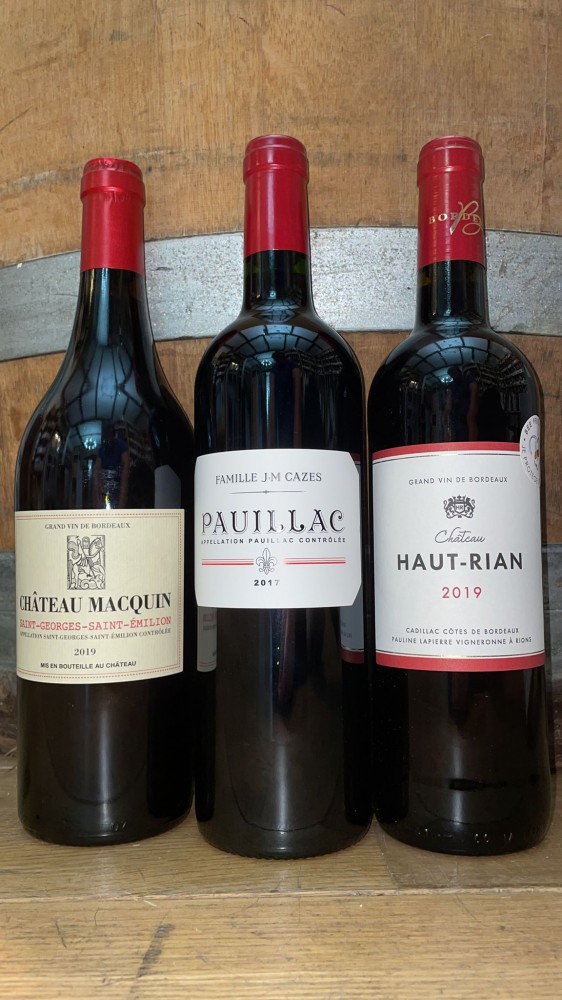
Regardless of what the future holds, here are some of our current favorite red wines from this behemoth of a wine region:
Chateau Haut Rian Rouge, Premieres Cotes de Bordeaux, 2019 £14.95
This wine is supple and well-structured with elegant tannins. Red and black fruits with notes of vanilla. Aged for 6 months in French Oak barrels. The vineyards are planted on Clay-Limestone and Clay-Gravel soils by the Garonne River, where the vines can see the water but won’t get their feet wet. A delightful Bordeaux that is great any day of the week.
Chateau Macquin, St-Georges St-Emilion, 2019 £23.95
Chateau Macquin is from the small satellite appellation of St-Georges St-Emilion, lying just 3km north of St Emilion. This predominantly Merlot blend is fruit forward in style with concentrated ripe red fruits alongside tobacco and subtle hint of sweet oak spices. Full bodied, it has silky tannins and a lovely backbone of acidity giving it real elegance and lightness.
Famille J M Cazes, Pauillac, 2017 £39.95
This wine comes from the prestigious Lynch Bages estate, this is made from 100% estate grown fruit, mainly from young vines and delivers delicious early drinking . Smooth and textured with a medium-weight palate of red fruits, herbs and kirsch. This great value third wine of Château Lynch Bages is a perfect example of the family's focus on quality and tradition.